
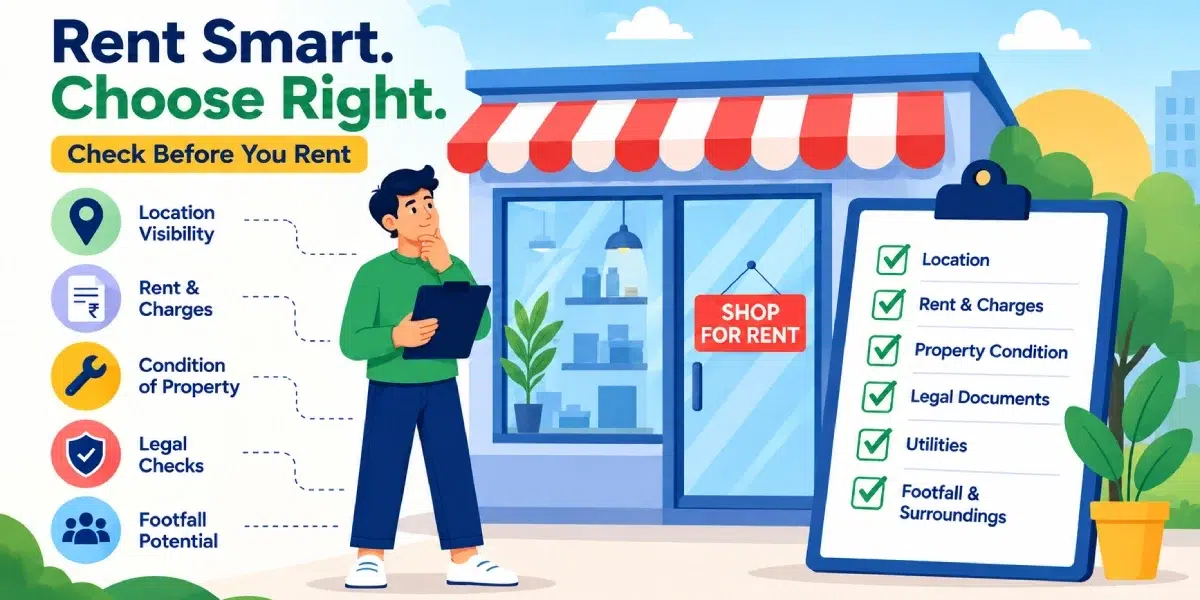
Most people searching for a shop for rent make the same mistake. They shortlist two or three options, compare the monthly rent, and choose the one that feels right. But there’s a lot more to consider before making that decision. Things like actual footfall, the total cost of running the space, and the lease terms can have a big impact on whether the shop actually makes money. A bad commercial lease isn’t just a one-time problem — it can keep adding to your costs every month for years.
This guide takes you through the whole process in a simple way — where to find verified retail spaces, what rents look like across six major Indian cities in 2026, how to judge a location using real data instead of just going by instinct, and what you need to check and sign before opening your doors. At Brokeraze, our advisors have helped retailers through this process many times, and one thing is clear: the retailers who do their homework before negotiating usually make better decisions.
Where to Find Verified Shops for Rent in India
Listing portals — and what they don’t tell you
We’ve all spent hours scrolling through property portals. They make house hunting look like online shopping—filter by budget, swipe through glossy photos, and click to explore. But if you’ve used them recently, you know the reality is a bit more frustrating.
Here is what the major listing sites usually leave out:
- Ghost Listings: A lot of the properties sitting online aren’t actually available anymore. Agents keep them up just to get your phone number, only to pivot and say, “Oh, that one just sold, but let me show you this instead.”
- The Telemarketer Loop: Ever click “Contact Agent” and suddenly get five different calls within ten minutes? That’s because portals sell your inquiry as a “lead” to multiple brokers at once.
- The Fine Print Costs: The price tag you see rarely includes the whole story. Maintenance fees, society charges, and hidden deposits usually pop up much later when you’re already deep into talks.
- Neighborhood Surprises: Maps can show you how close a school is, but they won’t warn you about the terrible traffic bottlenecks, waterlogging during heavy rains, or noisy surroundings after dark.
Property portals are great for a quick look around, but they’re built to generate leads, not give you the whole picture. For the real story, you still have to do the legwork yourself.
Why an advisory partner fills in what the portals can’t
A good rental advisor does the legwork no portal automates — screening listings for genuine commercial viability, matching tenants to the right catchment for their business category, and running the process end to end from shortlist to signed lease. Landlords get shorter vacancy periods and better-fit tenants; retailers get to negotiate with actual data instead of urgency and guesswork. If you’re searching for a shop for rent in a city you don’t know well, that local read is probably the single most valuable thing you can have before you sign anything — which is exactly the gap Brokeraze is built to close.
Property portals are built for volume. They want eyeballs, clicks, and a high number of listings. But a website can’t walk you through the anxiety of vetting property titles, warn you about micro-market issues, or look out for your financial best interest.
That is where a dedicated real estate advisory partner steps in—and why a human-led approach changes everything.
What an Advisory Partner Actually Solves
- Ground-Level Reality Checks: Instead of relying on doctored photos and generic location tags, an advisor knows the actual ground conditions—like which blocks face waterlogging during monsoons or which societies have hidden management disputes.
- Cutting Through the Spam: When you work with an advisor, your inquiry doesn’t get blasted to ten different telemarketers. You get a single point of contact who handles the vetting process so you don’t get hounded by cold calls.
- Total Cost Transparency: An advisor maps out the complete financial picture upfront—including hidden maintenance dues, registry nuances, and registry-related paperwork—so there are no unwelcome surprises on possession day.
What Shop Rent Actually Costs: City-Wise Benchmarks for 2026
Rent per sq ft across six major cities
The ranges below are best-available 2026 market estimates for monthly rent and rent per sq ft, drawn from a mix of high-street, secondary retail, and neighbourhood locations — not a citywide average. Premium high streets and mall units sit at the top of the range or above it. Ahmedabad numbers are based on tier-2 proxies, since city-specific data is thin, so treat those as indicative rather than precise.
| City | Monthly rent range | Rent per sq ft/month | Quick read |
|---|---|---|---|
| Mumbai | ₹50,000–₹1,00,000+ | ₹120–₹380+ | Wide spread — suburbs and premium streets like Linking Road (up to ₹1,100/sq ft) barely resemble each other |
| Delhi NCR | ₹60,000–₹1,50,000+ | ₹200–₹550 | Connaught Place and Khan Market pull the top up; secondary retail stays far more affordable |
| Bengaluru | ₹40,000–₹1,20,000+ | ₹180–₹250 | Brigade Road and Commercial Street set the benchmark; Jayanagar sits in the mid-range |
| Chennai | ₹35,000–₹1,00,000+ | ₹150–₹240 | Anna Nagar and Nungambakkam are the main retail corridors |
| Hyderabad | ₹40,000–₹1,00,000+ | ₹200–₹225 | Jubilee Hills is the prime end; Ameerpet and Kukatpally do volume |
| Ahmedabad | ₹25,000–₹80,000+ | ₹30–₹50 (proxy) | A strong, notably more affordable tier-2 market |
Don’t read the per-sq-ft number in isolation. ₹200/sq ft in Delhi NCR and ₹200/sq ft in Hyderabad represent completely different footfall, catchment, and competitive conditions. The number only means something once you know the micro-market it came from.
Deposits, brokerage, and the costs nobody budgets for
Renting a commercial space comes with a lot more expenses than just the monthly rent listed online. If you are budgeting only for the base rent, you are setting yourself up for financial surprises.
Here is a breakdown of the actual costs most people forget to plan for:
1. Security Deposits & Brokerage
- The Deposit: While the Model Tenancy Act suggests a six-month cap, reality varies. Quieter secondary markets might ask for two months, while premium high streets can demand twelve months or more. A safe working rule is to budget three to six months and treat anything higher as room for negotiation.
- Brokerage: There is no fixed government rule for brokerage, but one month’s rent is the standard market norm for direct commercial leases, though it fluctuates depending on the city and deal size.
2. The Hidden Cost Stack
Beyond rent and deposits, retail spaces come with heavy recurring operational expenses:
- Common Area Maintenance (CAM): If you are moving into a mall or a mixed-use development, CAM charges add up fast. Always ask for a detailed, line-item breakdown before signing, as costs vary drastically by property.
- Utilities: A basic small shop usually racks up ₹2,000 to ₹6,000 a month in electricity. If your setup requires refrigeration or heavy equipment, expect that bill to jump to ₹8,000 to ₹15,000.
- Fit-Out Costs: Getting the interior ready isn’t cheap. A standard mid-range retail interior generally runs ₹1,500 to ₹3,000 per sq ft, while a premium showroom can easily push past ₹5,500 per sq ft.
The true cost of running a shop is always significantly higher than the headline number on a listing portal. Make sure these figures are baked into your financial model before you sign on the dotted line, not after.
How to Read a Location Before You Commit
Finding the right commercial space takes a lot more than falling in love with a storefront or a clean floor plan. If you want to avoid an expensive mistake, you need to look past the surface and evaluate how the location actually performs.
Here is how to properly read a location before signing a lease:
1. Measuring Footfall Properly
A single Saturday afternoon site visit is the most common—and most misleading—way to check out a spot. It only shows you one slice of time and hides weekday traffic, weather shifts, or monthly lulls.
- Do the legwork: Track entrance traffic over two to four weeks, covering mornings, evenings, weekdays, and weekends.
- Track the right signals: Look at daily visit volumes, peak-hour crunches, how long people linger near your frontage, and signs of repeat visitors.
- Keep it practical: While tech tools like CCTV analytics, Wi-Fi sensing, and mobile location data make tracking easy at scale, old-school manual counting across a few time slots works just fine for smaller searches. Consistency is what matters.
2. Catchment Fit (Not All Footfall is Good Footfall)
A crowded street only helps your business if the people walking past are actually your target customers. A catchment analysis looks at where those visitors live, how they travel, and whether their income and demographic profile fit what you sell. A busy sidewalk with the wrong crowd is a bad investment, no matter how cheap the rent looks per square foot.
3. The Rent-to-Revenue Stress Test
Once the traffic and the catchment check out, you have to run the hard numbers:
- Take a realistic daily footfall estimate and apply a conservative conversion rate for your retail category.
- Factor in your average transaction value to project your actual monthly revenue.
- Ask the ultimate question: Does that revenue comfortably cover your rent, staff salaries, utilities, CAM charges, and still leave you with a real profit margin?
If the math doesn’t work out at the asking price, you either need to negotiate the rent down or walk away. A shop that “feels right” emotionally but fails the financial stress test is simply the wrong space for your business.
Lease Terms, Legal Documents, and Licences to Sort Before Signing
Renting a commercial space requires looking past the handshake and getting the legal framework right from day one. Here is a breakdown of the paperwork, protective clauses, and licenses you need to sort out before signing any agreement.
1. What Each Side Needs to Bring to the Table
Sorting out your documentation early prevents unnecessary friction down the road, especially since licensing processes rely on the exact same paperwork.
- The Landlord: Must provide proof of ownership (sale deed or title document), a government photo ID, and a No Objection Certificate (NOC) if there are co-owners, a housing society, or a financier involved.
- The Tenant: Needs a government photo ID, address proof, PAN, [Aadhaar Redacted], and relevant entity documents (if registering under a company, LLP, or partnership).
Having these ready means registrations can start the moment the lease is signed, rather than stalling over missing paperwork.
2. The Clauses That Actually Protect You
Eight key clauses define the real risk profile of a commercial lease:
- Property Description: Must state the exact address and carpet area—never rely just on a building name.
- Term & Renewal: Renewal terms should feature clear, specific conditions rather than a vague “landlord’s discretion.”
- Rent Escalation: Pushing back on annual escalations above 5% to 10% is standard practice.
- Security Deposit Refund: Insist on a hard timeline (typically 15 to 30 days after vacating) instead of an open-ended promise.
- Permitted Use: Explicitly outline your primary business activities and any necessary secondary uses.
- Maintenance Split: Clearly separate structural repairs (the landlord’s duty) from day-to-day upkeep (the tenant’s duty).
- Subletting Restrictions: Ensure the rules around subletting are spelled out, not left to assumption.
- Lock-In & Exit Terms: A lock-in period requires a balanced exit mechanism—such as a defined penalty instead of full-term liability—to avoid being trapped with zero flexibility.
3. The Licences You Actually Need
Most retail operations in India require three core registrations:
- Shop & Establishment Registration: A state-level requirement usually handled within 30 days of starting operations. Processing times typically range from 2 to 15 days depending on the state.
- Municipal Trade Licence: Issued locally to authorize your specific retail activity at that exact address.
- GST Registration: Mandatory once your turnover crosses the statutory threshold, or immediately if required by your specific retail category.
Pro-Tip: Make sure the landlord’s NOC is written directly into your lease agreement as a guaranteed right. Getting it later, when you have zero leverage, can stall your entire setup process.
Comparing Shops for Rent: A Pre-Signing Checklist
The Brick Wall Between You and a Commercial Lease
Walking into the commercial real estate market without preparation is like walking blindfolded through a minefield. Portals show you the highlight reel; the street shows you the bill.
If you want to secure a space that actually makes money instead of draining it, you have to look at the process in three uncompromising phases:
1. The Numbers They Hide
- The Real Cost Stack: Base rent is just the entry fee. Add a security deposit (anywhere from 2 to 12 months depending on the street), skyrocketing CAM charges in managed properties, commercial electricity bills, and interior fit-outs that easily demand thousands per square foot. If your financial model doesn’t account for every single one of these before you sign, you are playing a losing game.
- The Revenue Stress Test: Never trust a gut feeling. Map out realistic footfall over weeks—not a lucky Saturday—apply a conservative conversion rate, and check if the projected revenue survives after paying every expense. If the math only works at a lower rent, you negotiate hard or you walk away.
2. The Legal Traps
- The Paperwork Battleground: Landlords need to show clean titles, ownership proof, and explicit NOCs for co-owners or societies. Tenants need their entity documents and IDs ready from day one so licensing doesn’t stall.
- The Protective Clauses: A standard lease heavily favors the landlord. You have to force changes: cap annual escalations to 5–10%, tie your security deposit refund to a hard 15–30 day timeline after leaving, and replace a terrifying full-term lock-in penalty with a balanced exit clause.
3. The Launch Bottleneck
- The Licensing Reality: Shop and establishment registration, municipal trade licenses, and GST aren’t optional, and they all require the landlord’s explicit NOC. If that NOC isn’t written directly into your lease as a guaranteed right, you will find yourself begging a landlord for a signature when you have zero leverage left.
Portals exist to generate leads for brokers. Protecting your capital, your sanity, and your business timeline is entirely up to your own preparation.
Negotiation levers retailers usually leave on the table
A rent-free fit-out period of one to three months is achievable in most markets, especially where the space needs real work before you can trade — landlords generally prefer a short rent-free window over sitting vacant.
A deposit below the six-month norm is negotiable too, particularly with strong credentials or a guarantor. Capping escalation at 5% a year instead of accepting 10–15% is standard in well-negotiated leases. A flexible lock-in exit with a defined penalty rather than full-term liability is a reasonable ask most landlords will agree to in a competitive market. And landlord contribution toward common-area upgrades, signage, or frontage improvements is less common but worth raising if they’re keen to land the right tenant.
A Real Example: How One Retailer Avoided a Costly Mistake
A retail client approached Brokeraze after narrowing it down to two shops in Panipat. Both had almost the same rent per sq. ft., so on paper, either one seemed like a good option.
But after spending two weeks studying the footfall and catchment around both locations, the picture changed. The slightly more expensive shop was actually getting much more traffic from the kind of customers the retailer wanted to attract. A nearby residential area and a regular commuter route were bringing in the right audience — something that wasn’t obvious from a quick site visit.
The cheaper shop had plenty of people passing by, but most of them weren’t the retailer’s target customers. Once we identified the better location, we negotiated a rent-free fit-out period and a lower deposit. This helped the retailer keep more cash available during the first month of operations.
We also took care of the fit-out coordination, so the client didn’t have to deal with multiple vendors while getting everything else ready for the launch. From the initial footfall study to opening day, the whole process was handled together.
The Cost of Getting This Wrong Isn’t Worth It
Getting the right retail lease isn’t just about finding a shop and agreeing on the rent. There are a few important things you need to get right, and ideally, they should happen in the right order. Start by finding the right properties. Online portals are useful, but having an advisor who can actually tell you whether a location makes sense for your business can save you a lot of time and trouble.
Then look beyond the rent per sq. ft. Understand what rents are actually like in that area, how much deposit you’ll need, and what the total cost will look like. A shop that looks affordable at first can become expensive once everything is added up.
Location is another big one. Don’t rely only on what you see during a site visit. Look at actual footfall, the surrounding catchment, and whether the people coming into the area are the customers you’re trying to reach. It’s also worth checking whether the expected sales can realistically support the rent before you start negotiating. And finally, get the paperwork right. Lease terms, clauses, licences and other legal details should be checked before you sign, not after something goes wrong.
Missing even one of these steps can turn into an expensive mistake.
A bad lease can mean being stuck with high rent, a large deposit you can’t recover easily, money spent on a fit-out that doesn’t work, or even months of lost business. In the end, fixing a bad decision usually costs much more than getting it right from the beginning. Whether you’re looking for a shop for rent in a metro city or commercial space in a growing Tier-2 city, the basic process stays the same — and so do the risks.
Speak to a Brokeraze rental advisor to shortlist the right shop for your business. Whether you’re searching for a shop near you or looking across multiple cities, the first conversation is free and can help you figure out the right direction from the start.